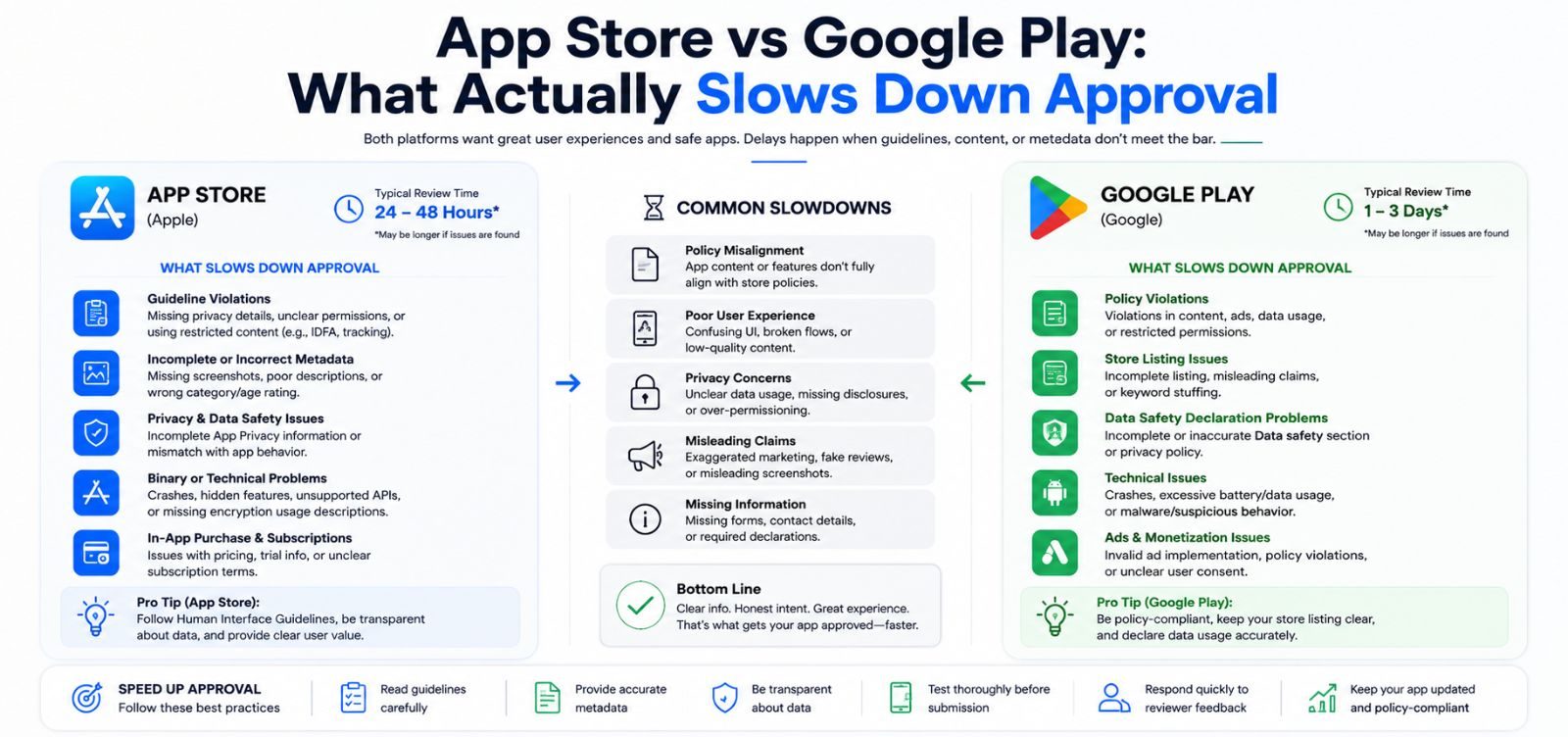
App store rejections feel arbitrary from the outside, but in practice they cluster around a fairly predictable set of issues on both platforms. Knowing these in advance saves a submission-rejection-resubmission cycle that can easily add a week or two to a launch timeline.
Incomplete or inconsistent metadata
Screenshots that don't match the actual current version of the app, a description that oversells functionality that isn't there, or missing privacy policy links are common, easily avoidable rejection reasons on both stores.
Broken core functionality during review
Reviewers will actually use your app, not just glance at it. If a key feature requires a login and there's no way for the reviewer to test it (no demo account, no guest mode), that alone can trigger a rejection or at least a delay while you provide access.
Apple's stricter design and guideline review
Apple's review process is generally more particular about interface guidelines and about apps that feel like a thin wrapper around a website rather than a genuine native experience. Google Play's review tends to focus more on policy compliance (data safety, permissions) than interface style.
Data and privacy disclosures
Both stores now require detailed disclosure of what data your app collects and why. Filling this out inaccurately — even unintentionally — is an increasingly common rejection reason as both platforms have tightened enforcement here over the last few years.
Building submission time into the plan
We build review time into launch timelines as a matter of course, rather than assuming first-submission approval. It's a much less stressful way to hit a launch date than hoping nothing gets flagged.