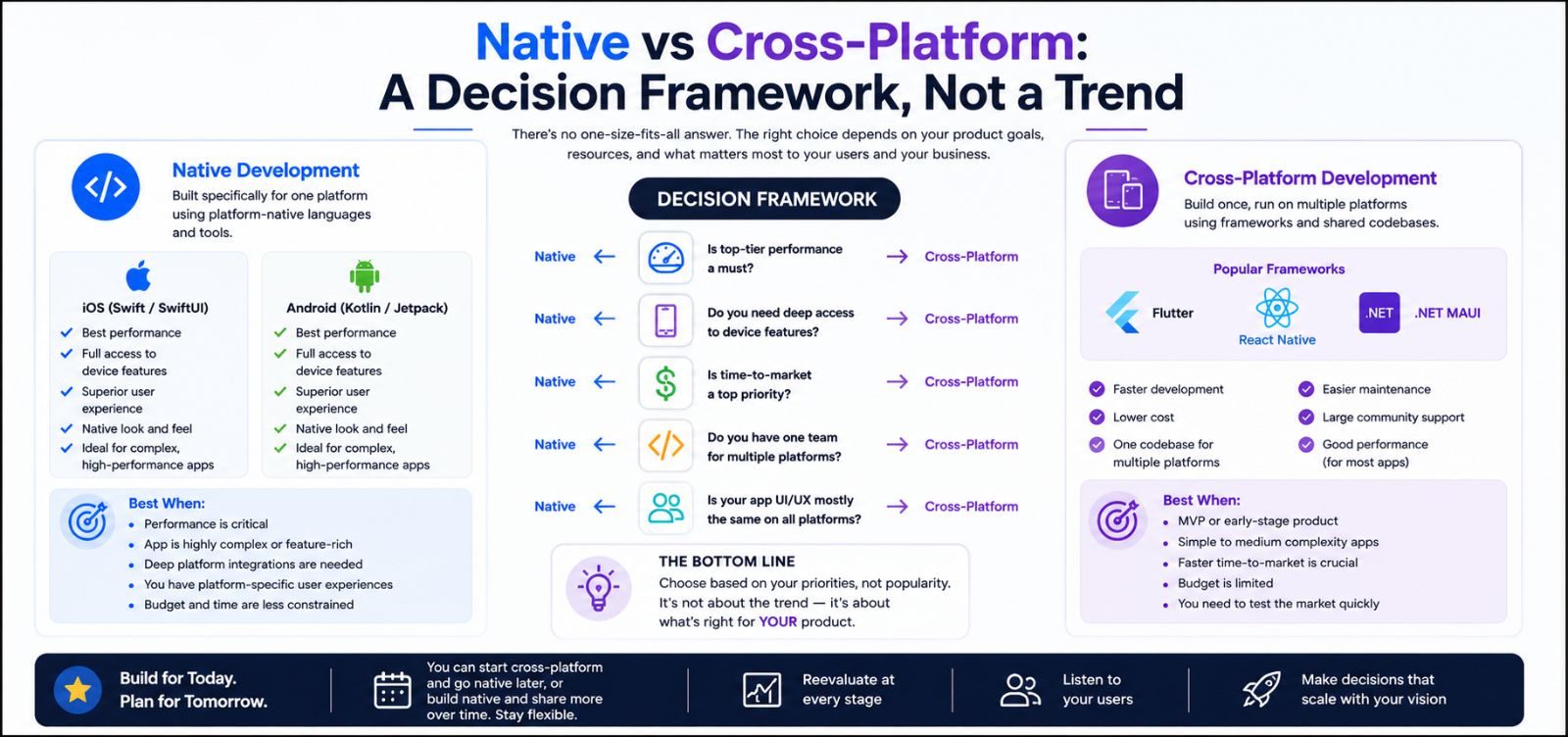
Native versus cross-platform is one of those debates that gets treated like a matter of opinion, when it's actually a matter of matching the approach to what your specific app needs to do. Here are the three questions that actually settle it.
Does your app need deep hardware or platform access?
Apps relying heavily on camera features, sensors, background processing, or platform-specific interactions (think advanced AR, or tight integration with Apple/Android-only features) usually need native development to perform well and avoid workaround bugs. If your app is mostly forms, lists, and content, this concern mostly disappears.
What's your actual budget and timeline?
Cross-platform frameworks let one codebase serve both Android and iOS, which is genuinely faster and cheaper for most standard apps. Building natively for both platforms roughly doubles the development surface, which only makes sense when the performance or platform-fit gain is worth that cost.
How performance-sensitive is the experience?
Apps with heavy animation, gaming-level graphics, or where every millisecond of responsiveness matters tend to still favor native. Most business apps — booking, ordering, account management, content — perform perfectly well cross-platform, and users generally can't tell the difference.
Our honest recommendation approach
We ask about your specific app idea, not your budget, first — and tell you honestly which approach fits before talking price. If cross-platform genuinely serves your use case better, that's what we recommend, even though it's the less expensive option for us to build too; there's no reason to sell you native complexity you don't need.